Our Advantages

CHIHAI: Your Professional Micro DC Reduction Motor Manufacturer!

Wide Product

Shenzhen Chihai Motor Co., Ltd., founded in 2002, is a professional manufacturer of micro dc motors and dc reduction motors. Our business started with micro motor, then developed several series of DC deceleration motor.

Professional Team

Our team members have years of experience and are experts in their respective fields. We have more than 210 skilled employees and 26 technical engineers.

24H Online Service

The needs of our clients are always our top priority. We listen carefully to their concerns and work collaboratively to find solutions.

Competitive Price

We offer competitive pricing on all of our products, and we work with our clients to create a budget that meets their needs.

First 1234567 Last
What is a Micro DC Reduction Motor?


The micro DC reduction motor is a general DC motor plus a matching gearbox, also called a gear reducer. DC gearbox reduction motor and DC gear motor. The role of the gearbox is to provide lower speed and higher torque. It usually has the characteristics of small size, low noise, durability, low energy consumption, and long service life.

DC Planetary Gear Reduction Motor With Encoder

Benefits of Using a DC Gear Motor


Increased Torque

The reduction mechanism increases the torque output, allowing the combined unit to power loads that require more torque than the motor alone can produce. For higher torque applications, you want to use metal gears, as opposed to plastic.

Reduced Speed

The gear reduction mechanism also reduces the rotational speed of the motor's output shaft. This can be beneficial in applications where high speeds are not required or desirable.

More Efficient Power Transfer

The gears in a gear motor can transfer power more efficiently than a direct drive motor.

Compact Size and Design

Combined power solutions are designed to be space-saving, both inline and right angle options are available. You can get a small DC gear motor, which is beneficial if space is limited.

Greater Flexibility

The ability to adjust the gear ratio to provide the desired operating conditions allows for more control over the torque and speed output, which is helpful in various types of applications.

 
Applications of Micro DC Reduction Motor

These motors are widely used in applications that require precise control, low noise, and high efficiency. Some of the common applications of micro DC reduction motors are:

Robotics

Micro DC reduction motors can provide smooth and accurate motion for robotic arms, legs, wheels, and grippers. They can also be integrated with sensors and controllers to achieve complex tasks and feedback loops.

Medical Devices

Micro DC reduction motors can power various medical devices, such as pumps, syringes, ventilators, and surgical instruments. They can offer high reliability, low vibration, and sterilization compatibility.

Consumer Electronics

Micro DC reduction motors can enable various functions and features in consumer electronics, such as cameras, printers, scanners, toys, and smart home devices.

Automotive

Micro DC reduction motors can drive various components and systems in automotive vehicles, such as windows, mirrors, seats, locks, wipers, and steering.

Important Parameters of the Micro DC Reduction Motor


The most important parameters in regard to gear motors are speed (rpm), torque (lb-in) and efficiency (%). A motor's performance and gearbox performance are combined into one graph by displaying three specific parameters. These performance curves are essential when selecting a motor for your application.


Speed/Revolutions (N)

(unit: rpm) indicated as a straight line that shows the relationship between the motor's torque and speed. It should be used near its peak efficiency to maximize the motor's potential.


Efficiency (η)

(unit: %) is calculated by the input and output values, represented by the dashed line. To maximize the motor's potential, it should be used near its peak efficiency.


Torque (T)

(unit: gf-cm) this is the load borne by the motor shaft, represented on the X-axis.


Current (I)

(unit: A) indicated by a straight line, from no load to full motor lock. This shows the relationship between amperage and torque.


Output (P)

(unit: W) is the amount of mechanical energy the motor puts out.

1

productcate-434-380


How to Read Performance Curves?

For example, let's consider the performance curve below (figure 5) for a DC motor.


1)Maximum operating efficiency (70%) for this motor would occur at 3.75 lb-in/2,100 rpm. As noted by the "Max. Rated Torque" plot.


2)As torque increases the speed and efficiency decrease. The result of increased torque is poor output performance and the device will eventually fail to function once the motor reaches its stall torque (18 lb-in).

How Do DC Gear Motors and Stepper Gear Motors Differ?
 

Speed Range

Stepper motors reach a maximum of 2000 rpm, while DC motors have a higher speed range.


Brushes

Stepper motors don't have brushes, while DC motors do.


Control

Stepper gear motors need a driver, for this reason, micro motors has designed a dedicated control board for its range of products. DC gear motors do not require external control to operate.


Motion

Stepper gear motors have an incremental movement, while the DC geared motors' is continuous.


Efficiency

Stepper gear motors have a very high current consumption at maximum load when the stator poles are excited, which reduces energy efficiency and increases heat losses. The maximum efficiency of the DC gear motor is reached at around 85%.


Durability

Stepper gear motors have a longer lifetime than DC gear motors because they do not have brushes, which are normally subject to wear and tear.


Applications

DC gear motors are mainly used in vending, ho.re.ca, industrial automation, and for other applications including printers and electrical suspensions adjustment.
Stepper gear motors are mainly used in applications requiring accurate positioning control, such as in robotics, home automation, telecommunication antennas, surveillance cameras, valves, airflow controllers, and projectors.

Maintenance Tips for Micro DC Reduction Motor


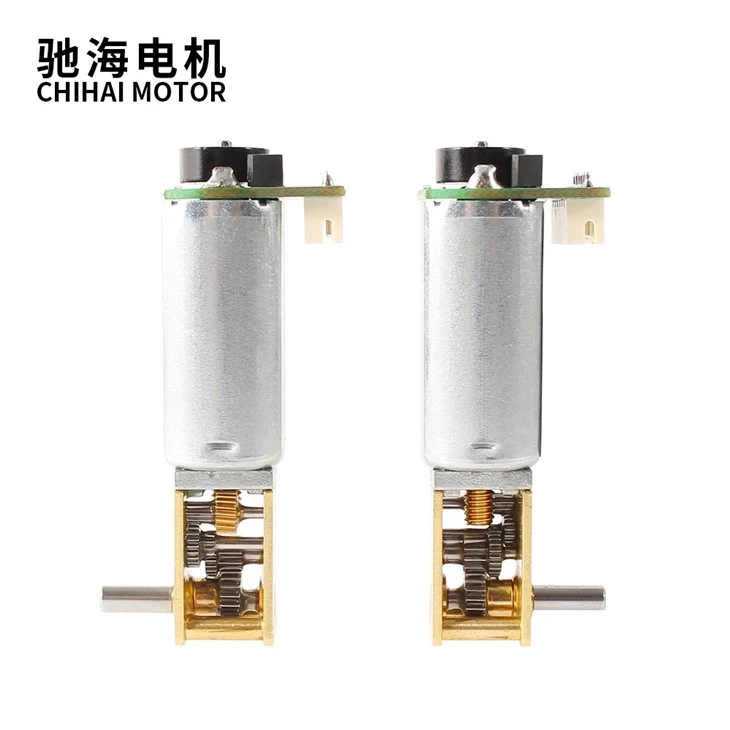
Mini DC Worm Motor With Encoder

Reviewing the Service History

DC gear motor maintenance, as with all types of industrial maintenance, requires pre-maintenance planning and scheduling. This starts with reviewing the motor's service history usually contained within an equipment maintenance log or, if the log is not available, interviewing the customer, operator, or responsible party to determine what type of maintenance is required, preventative or corrective (failure repair).

Noise and Vibration Inspections

Noises and vibrations are not limited to mechanical problems or imbalances; electrical imbalances, such as open or shorted winding or uneven air gaps, can cause noises or vibrations. The easy way to troubleshoot an electrical from a mechanical imbalance is to first power up the motor, then disconnect the power. If the noise/vibration exists while it is unpowered, the problem is mechanical; if the noise stops while the power is disconnected, the problem is usually electrical.

Visual Inspections

A visual inspection is meant to observe and record anomalies in the physical condition of the motor in a de-energized state. A motor that appears dirty, corroded, or has a "beat up" look indicates that it was operated in a rough environment and may have more problems than usual. This inspection should include the "smell" test. Is there a burned odor coming from the motor windings? The burnt smell is coming from the insulation varnish of the motor windings. If so, this suggests an overheating problem. Motor winding damage is possible under these conditions so winding tests should be conducted.

Bearings: Replacement and Lubrication

Lubrication is only one of three maintenance tasks involved with motor bearings. Cleaning, removal, and replacement are the other tasks. In the noise and vibration inspections, the bearings should have been inspected for abnormal noises, vibrations, or hot bearings. The "feel" and "sound" tests are simple methods to gauge bearing conditions. For the "feel" test, with the motor running, touch the bearing housing. If it is very hot to the touch, the bearing is probably malfunctioning. In the "sound" test, listen for thumping or grinding noises. If they exist, the bearings need a closer look and possible replacement. For most types, the sources of bearing failures are:
1)Insufficient oil or grease.
2)Too much grease causes churning and overheating.
3)Worn bearings (i.e., broken balls or rough races, etc.)
4)Hot motor or external environment.
 
Our Certifications and Airsoft Motor

productcate-800-572

productcate-750-750
 
productcate-750-747
 
productcate-750-776
 
productcate-750-623
 
Frequently Asked Questions about Micro DC Reduction Motor

Q: What is an DC gearbox reduction motor?

A: The DC gearbox reduction motor is equipped with a corresponding gearbox reduction box based on a general DC motor. The function of the gear reducer is to provide lower speed and larger torque. The gearbox reduction motor refers to the integrated body of the reducer and the motor (motor).

Q: How DC gear motor works?

A: The combination motor + gearbox is very effective since it allows even small devices, such as a mixer for dough or small drills, to produce a fairly high power despite the small size. The energy produced is transferred to a shaft at the other end, which converts this energy into a low-speed driving torque.

Q: What is the difference between DC motor and DC gear motor?

A: Geared DC motors can be defined as an extension of DC motor which already had its Insight details demystified here. A geared DC Motor has a gear assembly attached to the motor. The speed of motor is counted in terms of rotations of the shaft per minute and is termed as RPM.

Q: What are the advantages of DC geared motor?

A: DC Geared Motor's overload, start-up, braking torque is large; It is easy to control, DC Reducer Motor is reliable; DC Gear Box Motor's energy consumption is small when adjusting speed.

Q: Why do we use DC gear motor?

A: To reduce shaft speeds, many DC motors are paired with a gearbox. This helps to reduce the motor's shaft speed, and increase the torque output of the motor. In most cases, torque is increased by the ratio of the gear reduction, minus any losses in the gearbox.

Q: How much voltage required for DC gear motor?

A: The metal gears have better wear and tear properties. Gearbox is sealed and lubricated with lithium grease and requires no maintenance. Although motor gives 100 RPM at 12V, motor runs smoothly from 4V to 12V and gives the wide range of RPM, and torque.

Q: How do you change the speed of a gear motor?

A: The rotation speed of the DC gear motor can be adjusted by yourself. If the gear motor is not a DC gear motor, the rotation speed can be adjusted by DC supply power with an adjustable voltage function. The voltage of supply power high or low will affect the rotation speed of the DC gear motor.

Q: What happens if you run DC motor at lower voltage?

A: A DC motor's speed is directly proportional to the input voltage. The higher the input voltage, the faster the output speed. The lower the input voltage, the slower the output speed. We can control the speed independently of torque by manipulating the supply voltage using a DC motor control unit.

Q: What pressure is a DC reduction motor?

A: The operating pressure of gear motors is usually quite low: between 100 and 150 bar. Modern gear motors, however, are capable of operating at continuous pressures of up to 250 bar.

Q: How to increase torque of DC motor using gears?

A: If we want to increase the torque of the micro gear motor, just need to increase the gear stages. The more stages of gear, the lower the output speed, the greater the torque. The fewer gear stages, the faster the output speed, the less torque will be.

Q: What the tips for choosing a DC motor or a DC gear Motor?

A: Tip 1: Determine your speed, torque, and voltage
Voltage, speed, and torque are the three most important characteristics for any DC motor application. Once you've identified these factors, you're ready to go on your quest to find the best motor option. The trick is to utilize a motor at or near its peak efficiency.

At the commencement of the motor selection procedure, the motor voltage should also be determined. Your electrical power source, such as a 12-volt battery or power supply, will influence motor voltage. DC motors generally have a nominal voltage of 12 or 24VDC.

The easiest way to understand the connection between torque and speed is to examine a motor's performance curve, which is usually included in the motor specification. It is critical to pick a motor or brush DC gear motor that satisfies both your speed and torque requirements when choosing an efficient motor for your application.

Tip 2: Consider Size vs. Performance
Proper motor size is vital for all applications, but it may become a problem when a specific level of performance is needed. Larger motors are often more powerful than smaller versions. Depending on the needs of your application, you may have to compromise some performance aspects to assist in satisfying the size limits.

There are countless choices for meeting the size limits for the majority of applications by employing various kinds of motors and motor technology, such as brushless motors or motors with permanent magnets.

Tip 3: Brush DC gear motors provide more torque
Sometimes you need more torque than a conventional DC motor can physically provide. Using a brush DC gear motor will result in higher torque and decreased speed, depending on the gear ratio employed. Gear motors are classified into three types: spur gear motors, planetary gear motors, and worm gear motors. Each style of gearhead has specific benefits.
Stepper motors, brushless DC motors, and brushed DC motors may all be outfitted with a gearhead. Check out our design note: Planetary Gear Motors vs. Spur Gear Motors to understand more about the distinctions between the various gear motor types.

Tip 4: Establish your Duty Cycle
Your application's or gadget's duty cycle will determine which motor type is ideal. The operating and dwell durations, as well as the directional rotation, are critical components of your duty cycle. At the start of the motor selection procedure, the duty cycle should be determined.

We're professional micro DC reduction motor manufacturers in China for over 15 years, specialized in providing high quality customized products. We warmly welcome you to wholesale bulk micro DC reduction motor in stock here from our factory.

Send Inquiry