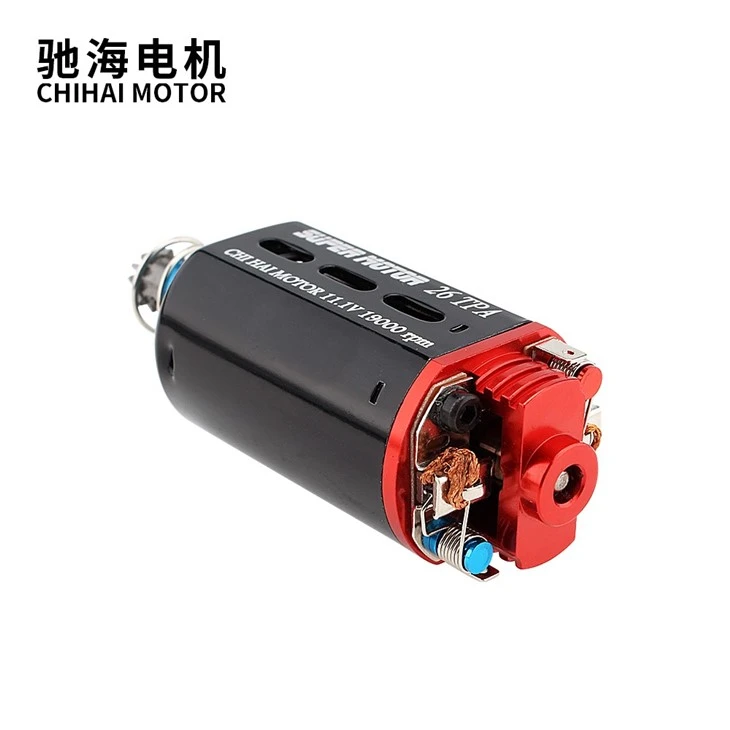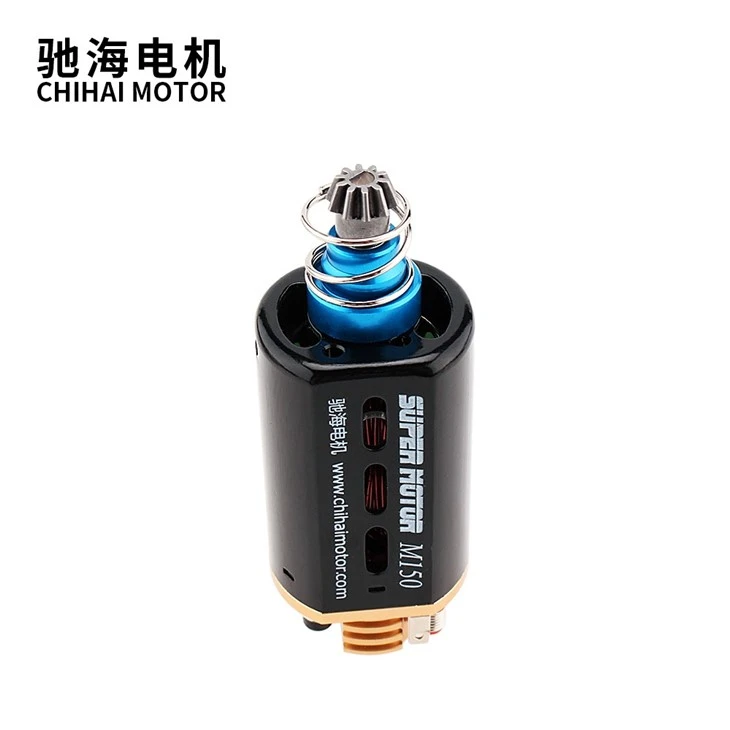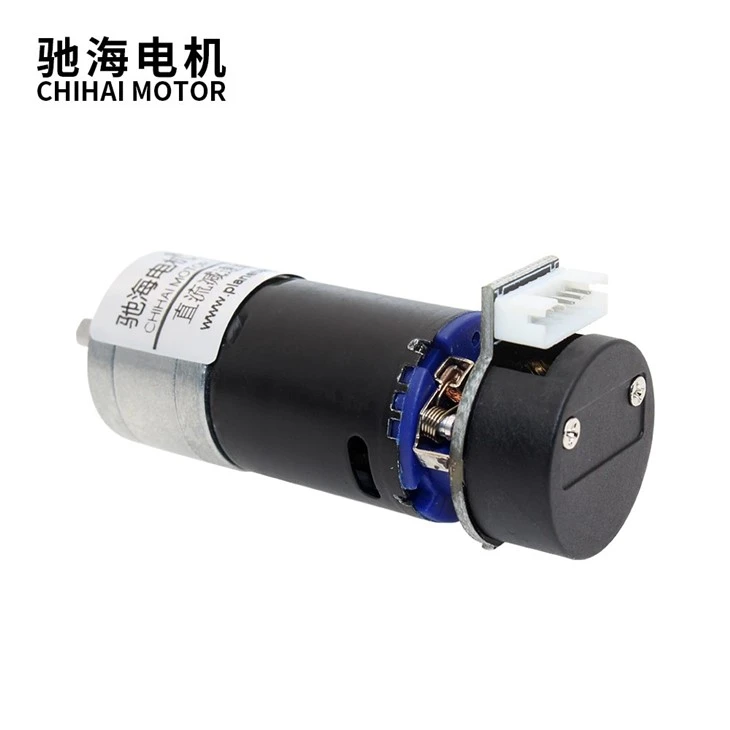
CHIHAI: Your Professional Mini DC Motor Manufacturer!


Wide Product

Shenzhen Chihai Motor Co., Ltd., founded in 2002, is a professional manufacturer of micro dc motors and dc reduction motors. Our business started with micro motor, then developed several series of DC deceleration motor.

Professional Team

Our team members have years of experience and are experts in their respective fields. We have more than 210 skilled employees and 26 technical engineers.

24H Online Service

The needs of our clients are always our top priority. We listen carefully to their concerns and work collaboratively to find solutions.

Competitive Price

We offer competitive pricing on all of our products, and we work with our clients to create a budget that meets their needs.

  • 45ZY-2480 Permanent Magnet DC Brushed Motor

    Product Description: Preferred Shell Material: The housing is made of seamless steel tube through spraying and stamping, offering high strength, stable performance, and reliable operation. Ball...

  • Permanent Magnet DC Coreless Motor Worm Shaft

    Product Description: Coreless cup deceleration: High transmission efficiency, low noise and high torque capacity. Ball bearing construction: Low friction resistance Low noise, long life Fast heat...

  • GM3865-520 Permanent Magnet Dc Geared Motor DC24V

    Product Description: All-metal gears: Adoption of all-metal gear material moret wear-resistant prolongs its service life Pure copper wire winding: The rotor part adopts pure, copper group, small...

  • CHU-1650 DC Coreless Brushless Motor

    Product Description: Strong Neodymium Iron Boron (NdFeB) Magnets: coreless motor with NdFeB magnets ensures stable performance and simple operation. Precision Machining: The motor housing is...

  • GW12T-N30VA DC Worm Gear Motor

    Product Description: Steel plate structure: the gear shaft of the reducer exhibits enhanced stability, extended longevity, and superior resistance to high torque loads Pure copper wire winding The...

  • GM29-N30 DC Variable Speed Motor

    Product Description: The secondary deceleration uses a bevel gear transmission structure to change the output direction, increase the reduction ratio, increase the torque, reduce the output speed,...

  • Permanent Magnet DC Coreless Gear Motor 6V 12V

    Product Description: All-metal gears: Adoption of all-metal gear material more wear-resistant prolongs its service life D shaft: More convenient installation, not easy to slip to Save installation...

  • DC Coreless Gear Motor M4 Thread The Shaft

    Product Description: Precision Military Quality High precision machined gears: Adoption of high-precision machined gears more wear-resistant prolongs its service life M4 Thread the shaft: Threaded...

  • With Rear-mounted Shaft DC Gear Reducer Motor

    Product Description: All-metal gears: Adoption of all-metal gear material more wear-resistant prolongs its service life Pure copper wire winding: The rotor part adopts pure copper group, small...

  • DC Worm Gear Motor Steel Gear 3V 6V 12V

    Product Description: Steel plate structure: the gear shaft of the reducer exhibits enhanced stability, extended longevity, and superior resistance to high torque loads Pure copper wire winding:...

  • Dc Secondary Variable Speed Motor GM29-N30

    Product Description: The secondary deceleration uses a bevel gear transmission structure to change the output direction, increase the reduction ratio, increase the torque, reduce the output speed,...

  • 380 HIGH SPEED MOTOR 11V 53000rpm

    Product Description: Double ball bearing: one on each side ,wear resistance, slow heat conduction Pure Copper Wire winding: Insulation coated powder rotor armature pure copper enamelledWires...

First 1234567 Last

What is a Mini DC Motor?


A Mini DC Motor, also known as small DC motor, is a small, electric motor that uses direct current (DC) to produce mechanical force. These motors are compact and find applications in a wide range of devices and systems.

 
Advantages of Our Mini DC Motor
 
Compact Size

DC motors are ideal for applications with space constraints due to their compact dimensions.

 
Efficiency

Direct current transmission and efficient design contribute to their high energy conversion efficiency.

 
Speed Control

Precise speed control is achievable through voltage regulation, making them adaptable to various tasks.

 
Quick Start and Stop

These motors exhibit rapid response times, making them suitable for applications requiring quick changes in motion.

 
Reliability

With fewer moving parts and simplified construction, small DC motors tend to have longer lifespans and reduced maintenance needs.


Design Principles of Miniature DC Motors

At the core of every small DC motor lies a series of critical design elements that contribute to their efficiency, precision, and reliability:

CHF-480WA HIGH Torque Motor

Armature and Commutator

The armature, a core component, houses the winding coils that interact with the magnetic fields. The commutator and brushes facilitate the flow of current, ensuring continuous rotation.

480 Medium Speed High Torque Shaft Motor

Permanent Magnets

These magnets create the static magnetic field within which the armature rotates, generating motion when the magnetic fields interact.

480 Medium Speed High Torque Shaft Motor

Brushes and Brush Holders

Brushes maintain electrical contact with the rotating commutator, enabling the transfer of electrical energy to the armature.

480 Medium Speed High Torque Shaft Motor

Enclosures and Bearings

Housing enclosures protect the motor's internal components, while high-quality bearings ensure smooth rotation and reduced friction.

 
Types of Mini DC Motor


DC motors are divided into two categories depending upon whether or not they use brushes and commutators: Brushed DC motors and Brushless DC motors
GM25-BK370 Hall Encoder DC Gear Motor

Brushed Dc Motors


Brushed DC motors work by direct connection to a source of DC electric power. They can be broadly divided into the following two types depending on whether they use permanent or electro-magnets.


1)Permanent magnet brushed DC motor

This is the most common form of electric motor used worldwide and includes the motors used in models and in the auxiliary motors of automobiles. They are further divided into slotted, slotless, and coreless motors depending on the configuration of the armature.


2)Electromagnet brushed DC motor

These types of motors use electromagnets to generate magnetic flux. They are further divided into distributed-winding, series-wound, and separately-excited motors depending on how the electrical connection between the field winding and armature winding is configured. This configuration is used for motors with medium to high output.

Brushless Dc Motors


Brushless DC motors require a drive circuit and work by supplying the appropriate current through static windings based on the detected orientation of the magnetic poles of the rotor. Because their windings remain static, brushless DC motors do not require brushes and a commutator. They are divided into the following types based on how the permanent magnets are attached to the rotor.


1)Surface permanent magnet (SPM)

The permanent magnets are attached to the outer circumference of the rotor.

2)Interior permanent magnet (IPM)

The permanent magnets are embedded in the interior of the rotor.

480WA-ATM High Torque Low Speed Motor

Applications of Mini DC Motor


At home, small DC motors are used in tools, toys and various household appliances. In retail, the applications of DC motors include conveyors and turntables, while in an industrial setting, large DC motor uses also include braking and reversing applications. Here are a few more specific uses for DC motors:

productcate-750-768

Dc Motors for Fans

Although fans traditionally use AC motors, there are an increasing number of DC motor ceiling fans hitting the market. These fans are gaining in popularity as they are far more economical than their AC equivalent, thanks to the way in which they operate.
DC motors utilize magnetic fields to process electrical energy into mechanical energy, and by using brushless motors, DC motor ceiling fans can be operated from standard household AC electricity. The only real downside to the DC motor fan is its cost, but the energy savings easily offset this.

Dc Motors for Pumps

Hydraulic pumps are an essential industrial tool, which are used in almost all industries including construction, mining, manufacturing, and steel. DC motors are used to power these pumps because of their easy variable speed control and excellent response when moving.
Like ceiling fans, the DC motor pump has also benefited from the development of lower-cost brushless DC motors, which are far easier to maintain on such a large industrial scope.

Dc Motors for Toys

DC motors for toys are a popular choice for manufacturers and hobbyists, with these 'toy motors' often used in children's toys such as remote control cars and model trains. Small DC motors work well in this setting, as they are easy to use and extremely rugged.
The wide variety of voltages for DC motors means they can be used for toys that require different speeds and movement types, and those that need a DC motor with the controller.

Dc Motors for Electric Cars

While there are a variety of different motor types used in electric cars, DC motors for electric vehicles are widely used because of their energy efficiency and durability.


In addition to professional manufacturers, many hobbyists and kit car makers prefer large DC motors for their higher starting torque, particularly series wound motors, and their variable speeds with voltage input.

Dc Motors for Robots

'Robot' is a broad term, but for many hobbyists and engineers, robots are any electromechanical device designed to achieve a specific task. DC motors for robots are used to 'actuate' something, such as tracks, arms, or cameras, this motor is particularly popular for several reasons.


DC motors are particularly convenient, as they have high torque and efficiency, making them ideally suited to robotics.

Dc Motors for Bikes

Electric bikes are popular because they do not require a license if the maximum assisted speed is under 20 miles an hour. To ensure the power levels and the torque needed, brushless DC motors are usually used for electric bikes.


Electric bikes use a compact DC motor built into the hub of the back or front wheel, or mounted in the center of the bike and connected to the pedal sprocket.

 
How to Check a mini DC Motor?
Disconnect the Motor from the Power Source and Prep the Wire Ends for Diagnostics

Use a screwdriver to remove the set screws from the wire connections running between the motor and battery. Once removed, disconnect the wires so the motor can't get power.


If necessary, expose the ends of the wires so you can use them to complete the test circuit.

Detach the Motor from Its Machine Housing

Remove the DC motor from its machine housing so the rotor can move freely during diagnostics. Depending on the motor type, you'll either have metric or SAE bolts, so make sure you have the right tools for the job.

Prepare the Volt-Ohm Meter for Testing

Set the volt-ohm meter to its ohms setting. Plug the red volt-ohm meter lead into the ohms point, and the black lead into the ground point. Attach the alligator clip leads to each motor power input wires. Touch the two leads together and ensure the volt-ohm meter reads zero ohms.

Run the Test

Checking a DC Motor for Defects. Touch the exposed wires of the motor with the volt-ohm meter leads. Black goes to black and red goes to red. Now, read the screen and determine the results:


1)10 to 100 ohms: This is a low resistance range and indicates there is nothing wrong with the motor.
2)Infinite ohms: This means there is an open circuit and requires further testing.

Rotate the Motor's End Shaft and Take Note of the New Readings

Slowly rotate the motor's shaft. If the meter readings change while the shaft is in motion, the motor is good, but there's a problem with the circuit. If the meter readings still show an open circuit, there's an issue with the motor. In most cases, you'll find it's one of three issues:


1)A short in the ground
2)Bad conductive bushings
3)A failed commutator

Test for a Short in the Ground

Find a metal part of the frame's motor and attach the black alligator clip to it. If the meter shows an open circuit, there is a short in the ground.

Remove and Inspect the Bushings

Locate the motor bushings under the plastic end caps on the other side of the driveshaft. Use a screwdriver to remove the bushings and then inspect them.


Look for cracks or breaks across the surface of the bushings. There should be a smooth curve where the bushings sit against the commutator. If you find no defects, the problem is usually the commutator.

Remove and Inspect the Commutator

Remove the two screws that run the length of the motor and take off the rear end cap. Inspect the plates that make up the commutator assembly.


You should see an opening between each plate and no broken wires or burnt varnish. If you find anything else, the commutator has failed, and you'll need to replace the damaged parts.

 
Products Description


The difference between AC and DC motors is extremely important not only from the examination point of view, but also for various projects and practical demonstrations. By knowing the AC and DC motor differences, choosing the right one for a particular demonstration becomes easy. For engineering aspirants also, this topic holds extreme importance.


Sl. No. Differentiating Property AC Motor DC Motor
1 Definition An AC motor can be defined as an electric motor that is driven by an alternating current (AC). A DC motor is also a rotatory electric motor that converts Direct current (DC energy) into mechanical energy.
2 Types AC motors are mainly of two types – synchronous AC motors and induction motors. DC motors are also mainly of two types – DC motors with brushes and DC motors without brushes.
3 Current Input AC motors only run when an alternating current is given as input. DC motors will only run when a DC supply is given. In the case of an DC series motor, the motor might run with an AC supply. But, for shunt motors, the motor never runs on an AC supply.
4 Commutators and Brushes Commutators and brushes are absent in AC motors. Commutators and carbon brushes are present in the DC motors.
5 Input Supply Phases AC motors can run on both single-phase and three-phase supplies. DC motors can run only on single-phase supply.
6 Starting of Motor A three-phase AC motor is self-starting, but a single-phase AC motor requires a starting mechanism. DC motors are always self-starting in nature.
7 Armature Characteristics In AC motors, the armature is stationary while the magnetic field rotates. In DC motors, the armature rotates while the magnetic field remains stationary.
8 Input Terminals In AC motors, three input terminals (RYB) are present. In DC motors, two input terminals (positive and negative) are present.
9 Speed Control The speed of an AC motor can be changed by varying the frequency. In the case of DC motors, speed can be controlled by changing the armature winding current.
10 Load Change AC motors show a slow response to the change in load. DC motors show a quick response to the change in load.
11 Life Expectancy Since AC motors do not have brushes and commutators, they are very rigged and have a high life expectancy. The brushes and commutators in DC motors limit the speed and reduce the life expectancy of the motor.
12 Efficiency Due to induction current loss and motor slip, the efficiency of the AC motor is less. The efficiency of the DC motor is high as there is no slip and induction current loss.
13 Maintenance AC motors require less maintenance as brushes and commutators are absent. DC motors require excessive maintenance due to the presence of brushes and commutators.
14 Applications AC motors are required where there is a need for high speed and variable torque. DC motors are required where there is a need for variable speed and high torque.
15 Practical Uses They are mainly used in large industries. They are mostly used in small domestic appliances.


Our Certifications and Airsoft Motor

productcate-800-572

productcate-750-672
productcate-750-618
productcate-750-673
productcate-750-724
Frequently Asked Questions about Mini DC Motor

Q: What is a mini DC motor?

A: A direct current (DC) motor is a type of electric machine that converts electrical energy into mechanical energy. DC motors take electrical power through direct current, and convert this energy into mechanical rotation.
DC motors use magnetic fields that occur from the electrical currents generated, which powers the movement of a rotor fixed within the output shaft. The output torque and speed depends upon both the electrical input and the design of the motor.

Q: How DC motors work?

A: DC motors include two key components: a stator and an armature. The stator is the stationary part of a motor, while the armature rotates. In a DC motor, the stator provides a rotating magnetic field that drives the armature to rotate.

A simple DC motor uses a stationary set of magnets in the stator, and a coil of wire with a current running through it to generate an electromagnetic field aligned with the center of the coil. One or more windings of insulated wire are wrapped around the core of the motor to concentrate the magnetic field.

The windings of insulated wire are connected to a commutator (a rotary electrical switch), that applies an electrical current to the windings. The commutator allows each armature coil to be energized in turn, creating a steady rotating force (known as torque).

When the coils are turned on and off in sequence, a rotating magnetic field is created that interacts with the differing fields of the stationary magnets in the stator to create torque, which causes it to rotate. These key operating principles of DC motors allow them to convert the electrical energy from direct current into mechanical energy through the rotating movement, which can then be used for the propulsion of objects.

Q: Who invented the DC motor?

A: This amazing piece of electrical equipment has revolutionised our lives in many ways, but who invented the DC motor? As with all major innovations, there are many people who had a role to play through the development of similar mechanisms.

In the US, Thomas Davenport is widely celebrated as the inventor of the first electric motor, and undoubtedly he was the first to patent a useable electric motor in 1837. Davenport, however, was not the first person to build an electric motor, with various inventors in Europe having already developed more powerful versions by the time Davenport filed his patent.

In 1834, Moritz Jacobi had presented a motor that was three times as powerful as the one Davenport would later patent, while Sibrandus Stratingh and Christopher Becker were the first to demonstrate a practical application for an electric motor, by running a small model car in 1835.

The first practical DC motor was invented some years later in 1886 by Frank Julian Sprague, whose invention lead to the first motor powered trolley system in 1887, and the first electric elevator in 1892. Sprague's DC motor was a hugely significant development, leading to a variety of applications which would reshape the face of industry and manufacturing.

Q: What are the uses of mini motor?

A: The uses of small/mini motors involve in several many applications like designing sample mini motor projects, CD/DVD players, hard drives, fans, pumps, coffee machines, robotic vacuum cleaners, hairdryers, mixers, bread cutters & spindle drives within modifiable or changeable speed applications.

Q: What application is a DC motor applicable to be used?

A: Major applications for DC motors are: elevators, steel mills, rolling mills, locomotives, and excavators. Like other rotating machines, DC motors result from the interaction of two magnets. The interaction is best understood as one of like poles repelling (north poles repel north poles, south poles repel south poles).

Q: Where are small DC motors used in everyday life?

A: At home, small DC motors are used in tools, toys and various household appliances. In retail, the applications of DC motors include conveyors and turntables, while in an industrial setting, large DC motor uses also include braking and reversing applications.

Q: Can I connect mini DC motor directly to battery?

A: Yes, it will be much happier than if you plug it into a wall socket. The wall socket is mist likely AC & all batteries are DC. If the motor & battery are rated for the same voltage & the battery has enough capacity to supply the motor load, There's no problem.

Q: What is the voltage of a mini DC motor?

A: For mini DC motors, the operating voltage ranges from 1.5 to 100V. Common motors include the mini DC motor 3V, mini motor DC 6V, and miniature 12V DC motor. At higher voltages, electronics are typically more efficient for running motors.

Q: Which type of motor is used in small toys?

A: Toy Small Motor 3-6V DC is a small motor usually use in toys or Robotic projects for running as a base motor with a 5v supply. This motor is popular among kids since it's used in every running toy like Car, Truck, Bulldozer, etc.

Q: How long can a small DC motor run continuously?

A: The continuous running time of a DC motor depends on various factors such as its size, power rating, design, temperature, load, and cooling system. In general, most DC motors can run continuously for several hours to several thousand hours, depending on their specifications and operating conditions.

Q: How long do small DC motors last?

A: The general service life of DC motors is about 20,000 to 100,000 hours. Some high-quality motor manufacturers will have corresponding technologies to make the DC motor last longer, such as oil-free lubrication, sealed bearings, overheating protection, and significantly improved commutator life.

Q: How fast does a small DC motor spin?

A: DC controls adjust speed by varying the voltage sent to the motor (this differs from AC motor controls which adjust the line frequency to the motor). Typical no load or synchronous speeds for an AC fractional horsepower motor are 1800 or 3600 rpm, and 1000-5000 rpm for DC fractional hp motors.

Q: How much torque does a small DC motor have?

A: We offer a variety of gearheads and encoders. Portescap small DC motors can deliver a torque range from 0.36 mNm up to 160 mNm continuously and from 2.5 mNm up to 1,487 mNm in intermittent operation.

Q: Can I run a 12V DC motor on 5V?

A: DC controls adjust speed by varying the voltage sent to the motor (this differs from AC motor controls which adjust the line frequency to the motor). Typical no load or synchronous speeds for an AC fractional horsepower motor are 1800 or 3600 rpm, and 1000-5000 rpm for DC fractional hp motors.

Q: How fast does a small DC motor spin?

A: Probably not. The motor will not have much torque, if any. Depending on the motor size the current draw will go up and is likely to be more than the charger can supply. 5Vdc is less than 1/2 the expected drive voltage of 12Vdc.

Q: Are DC motors expensive?

A: DC motors generally cost significantly more than AC motors due to their higher manufacturing costs. Also, because AC induction motors have such widespread use, economies of scale contribute to their relatively lower price. This means that AC motors are used for most large-scale industrial applications, whereas DC motors are found in smaller applications that require fine speed control, such as robotics.

We're professional mini DC motor manufacturers in China for over 15 years, specialized in providing high quality customized products. We warmly welcome you to wholesale bulk mini DC motor in stock here from our factory.

Send Inquiry